Slagworks Becomes Fatecaller
The card game from the last two articles is now called Fatecaller, and it lives at fatecaller.com. Same rules engine, same balance instruments, same everything that mattered. This article is about the week where it stopped being a tech demo with a placeholder name and started being a game with a campaign, a battle line, and a front door. If you have not read the balancing story or the engine transplant, they stand on their own, but this one picks up where they left off.
the TypeScript build · same rules engine the server runs · play full screen ↗
That is the live game, same as ever. What changed is everything around the rules.
Killing a name properly
I was never in love with Slagworks. It sounded industrial in a way the game never earned, and worse, Warcraft players kept a corner of my brain reserved for the Slag Works in Blackrock Depths. A placeholder name is fine for a prototype. It is not fine for a thing you want strangers to remember.
So I asked Claude to run the rename the way you would run any other engineering problem: enumerate candidates, then try to kill each one. The kill tests were concrete. Is the dot com available. Does the USPTO show a live trademark in games. Does Steam already have something confusable. And the test that eliminated the most candidates: say it out loud and imagine a twelve year old repeating it. One candidate did not survive my mental playground test, and another died because nobody would ever spell it right on the first try. Naming is mostly subtraction.
Fatecaller survived every test. The domain was open, the trademark lane was clear, Steam had nothing adjacent, and you cannot misspell it. I bought fatecaller.com the same afternoon.
The real reason it won, though, is that the name was already true. The design decision that has carried this whole series is that the shuffle is the only randomness in the game. Every spell targets deterministically. Every fight resolves exactly as read. A player who studies the board can call the future, and the only thing fate hides is the order of the deck. The industrial theme never had anything to say about that. A game about reading fate does. The re-theme wrote itself from there: the factions became Emberseers, Wardens, and the Manyfold, rigs became omens that spring when the enemy acts, sacrifice effects became offerings to fate, recurring effects became rites. One hundred nineteen cards renamed in an afternoon, and for the first time the flavor and the rules are telling the same story.
A line instead of a bag
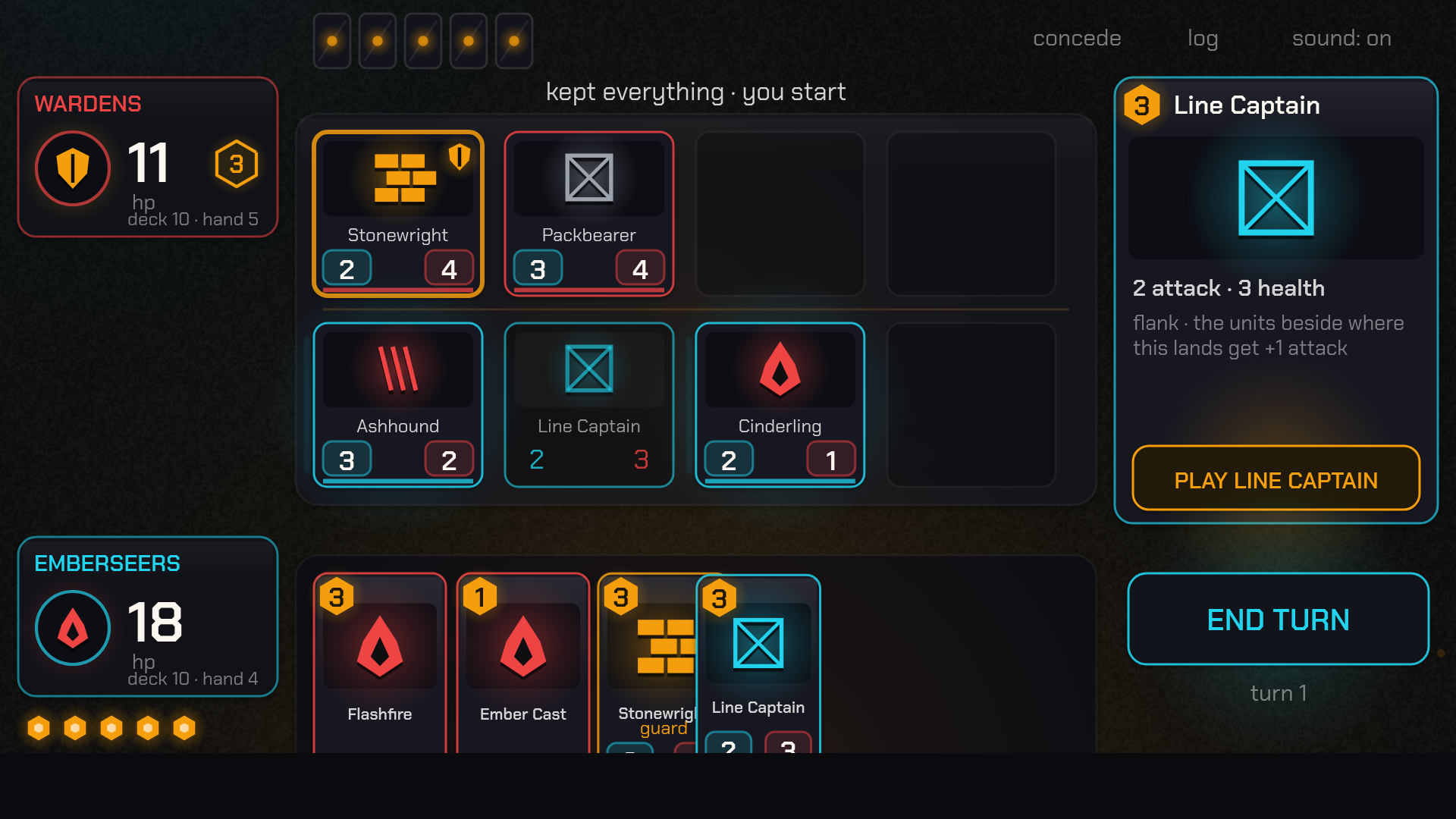
The first mechanical addition under the new name was positioning. Boards in this game had always been bags: four units a side, order meaningless. Set nine turned each side into an ordered line and added cards that care about it. Flank units buff their neighbors as they land. Phalanx units grow with each adjacent ally. One spell chains damage outward from its target to the units beside it. Another strikes both ends of the enemy line.
The design constraint came from a lesson the balancing article already paid for: an instrument can only certify what it can see. The greedy bot that balances this game evaluates states, so positional effects resolve at the moment a card is played and bake into stats, where every instrument in the pipeline can price them. No persistent auras drifting in and out as the line shifts. That is a real design ceiling, and I have plans to raise it later, but it bought something valuable: the positioning set went through the full certification spiral and passed on the first attempt, both seeds, every matchup inside the band. While putting this article together I had Claude rerun the arena, four hundred games per pairing: worst matchup 41.8 percent, best 54.5. The line did not break the wheel.
Teaching my hand where the card lands
The mechanic was the easy half. The interface took three tries, and every iteration started with me being confused in a specific way, which I have come to believe is the most useful thing I contribute to this project.
Version one: tap a friendly unit to insert the new card before it. I played it, tried to put a unit on the left flank, and could not figure out how. Nothing on the screen said the units themselves were the drop targets. I told Claude it was not obvious and asked for a preview of where the card would go.
Version two: the whole line became tiled drop zones. Hover a position and a bright insert bar lit up with a small ghost of the unit floating above it. Better. But the bar squeezed between cards, and the board did not react at all until the moment the card landed.
Version three is the one that shipped, and it is the one every Hearthstone player already knows in their hands: pick a unit and the line physically slides apart to open a full card gap where your cursor points, with a translucent ghost of the unit breathing gently in the gap. Faint markers remain for touch players, where there is no hover. The insight, which Claude articulated better than I had, is that the units sliding out of the way is not decoration. It is the interface answering the exact question the player is asking, which is what will the world look like after I act. In a game whose entire thesis is that you can read the future, the placement preview is the thesis in miniature.
The tutorial is secretly a campaign engine
The game needed onboarding. Watching anyone new hit the old build made that obvious: the first screen was three decklists full of names that mean nothing to a person who has not played.
Determinism made the fix cheap in a way I did not expect. A coached tutorial is normally fragile because the game state can wander away from the script. Here, the tutorial pins the exact deck order, so every coaching step is always true. Play Emberdart. It has rush, attack the hero. The foe raises a guard, see the amber shield. Clear it, place your Warcaller anywhere in the line, finish the duel. Ten steps, each one gated so only the taught action goes through, with a pulsing highlight that tracks the exact card even as it lifts under your cursor. Claude drives the whole sequence in an automated test, clicking through every step and asserting the state after each, because a tutorial that can silently break is worse than no tutorial.
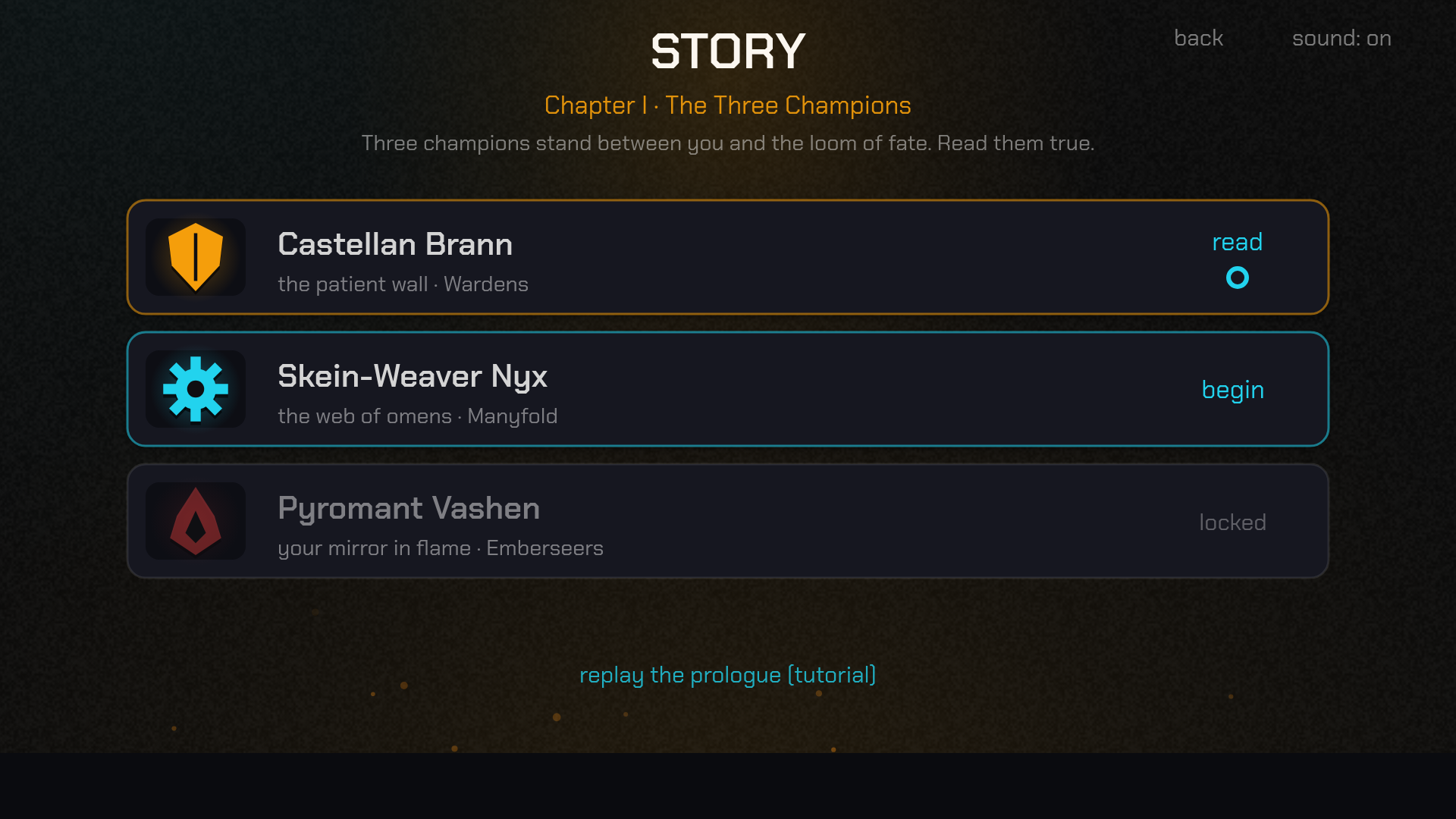
The interesting part is what the tutorial turned out to be underneath: a scenario layer. Fixed setup, scripted or real opponent, optional coaching. The tutorial is scenario one. Story mode is scenarios two through four, and it cost almost nothing extra: three named champions, each a real fight against the live bot with a narrative intro and one tactical tip. Castellan Brann teaches you to break walls on easy. Skein-Weaver Nyx races you through a web of omens on normal. Pyromant Vashen is your own deck in the mirror on hard, and the campaign ends only when you beat it for keeps. Win to unlock the next, lose and retry. New chapters are pure data now, a list of entries in one file.
Paper cuts under a microscope
Between features I asked for a systematic polish pass, because the previous week I had been finding rough edges one at a time in play, and each one I found suggested others I had not. Claude built a harness that stages any screen of the game headlessly and screenshots it, then walked every screen looking for dead ends and lies.
The sweep found little, which after that much churn was the encouraging result. The over screen said 1 turns. Omen cards still labeled themselves with an internal word from the old theme. A draft run had no way back to the menu except losing three times, which a player had to actually experience to discover. And the random-click monkey, fifteen hundred taps a run, caught a new back button Claude had placed directly on top of the global sound toggle, on two different screens, before any human ever saw it. The instruments from the balancing era have quietly become UI instruments. Same philosophy, smaller stakes, same payoff.
A front door
Until this week the game lived in a sixteen by nine box halfway down a portfolio page, which is a strange place for something you want people to actually play. Now it fills the screen, letterboxed clean on any display, with a proper fullscreen button, and it answers at fatecaller.com. One honest note from the domain move: the elegant path, delegating the nameservers to the host, turned out to be a dead end the host would not provision, and after an hour of refused zones the boring fix, two A records at the registrar, worked in minutes. Infrastructure has its own totem poles.
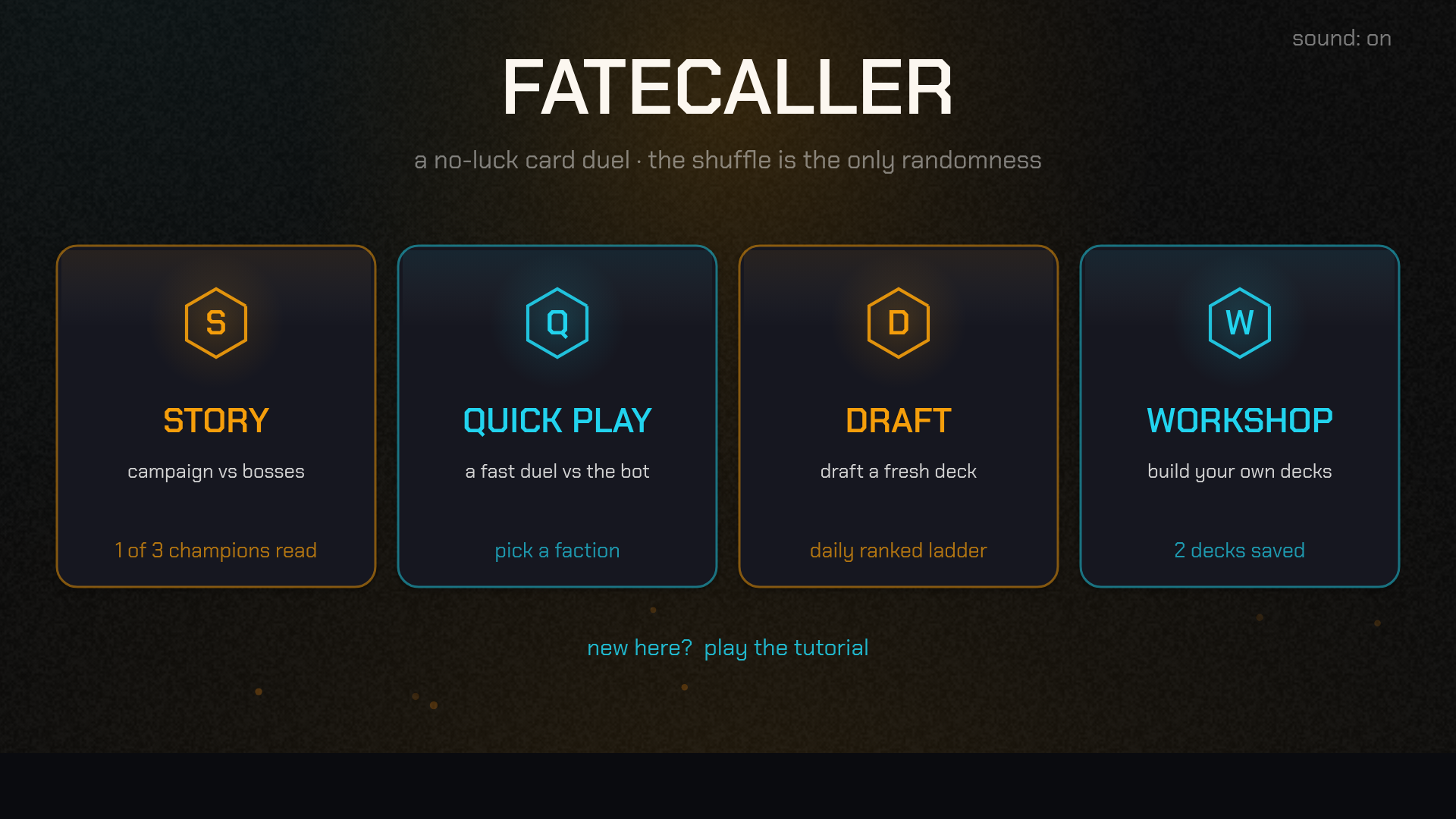
The home screen got rebuilt to match the game it now fronts. The old landing led with three decklists, which is to say it led with the least legible thing the game owns. The new one leads with the four things you can actually do: Story, Quick Play, Draft, Workshop, each with a line of state so the screen remembers where you are. The faction pick still exists, one tap down, inside Quick Play where it belongs.
The empty leaderboard
Here is the honest ending. Before publishing this I had Claude pull today's daily leaderboard: zero runs posted. Not few. Zero. The game has three modes, a campaign, a certified metagame, an anti-cheat leaderboard, and no audience at all, because until yesterday it had no front door and I have told exactly nobody about it.
The last two articles ended by pointing at the next instrument. This one is no different, except the thing being measured has changed. The game is built. What does not exist yet is a reason for a stranger to arrive today and come back tomorrow, and the plan for that is already on the bench: a daily puzzle, one exact lethal hiding in a fixed board, provable because the whole game is deterministic, shareable because a solve compresses to a few characters. The balancing instruments measured the decks. The next instrument measures whether anyone shows up. I suspect that one measures me too.
The puzzle got built, and it was only the beginning: what one deterministic design decision kept paying for is the next article.